Match types have quietly become one of the most misunderstood parts of Google Ads. Broad match behaves nothing like it did five years ago; exact match isn't as exact as it sounds. Here's how to use each in the modern platform.
Broad match
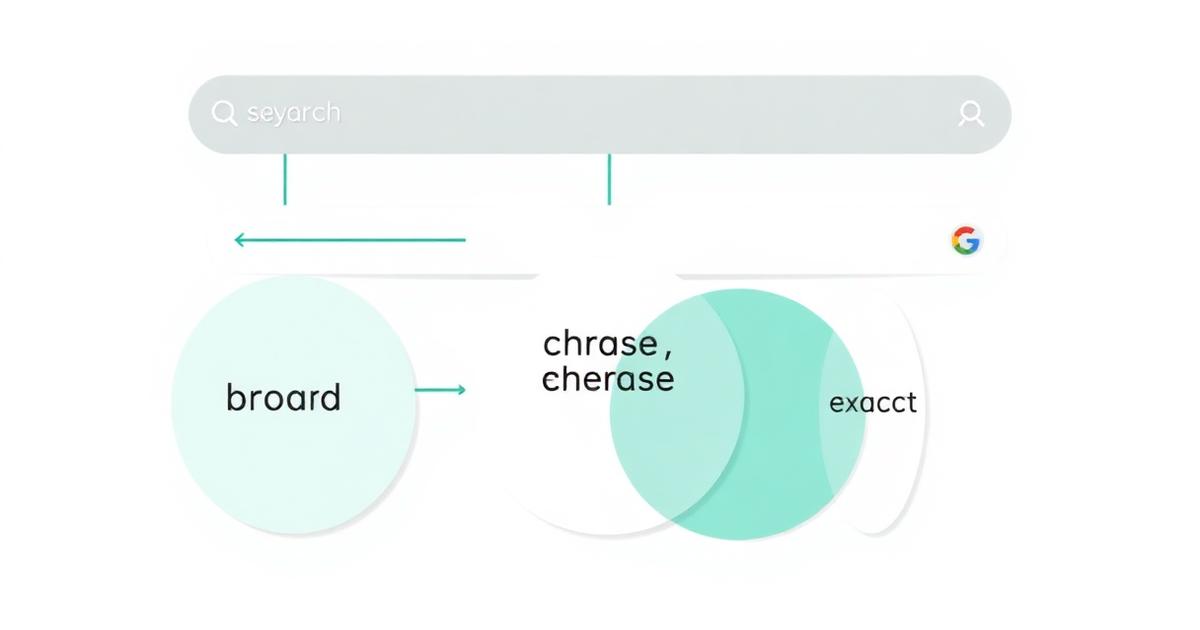
Broad match now considers the meaning of the keyword, related searches, past search history and the landing page — not just the words. It can be powerful with strong conversion tracking and Smart Bidding (tCPA or tROAS). Without those, it will spend fast and cover intent you didn't want.
- Use with: Target CPA or Target ROAS bidding, at least 30 conversions/month.
- Never use with: Manual CPC or thin conversion data.
- Layer aggressive negative keyword lists — broad match reveals surprising search terms fast.
Phrase match
Phrase match now matches the meaning of your keyphrase, not just the exact word order. It's the modern workhorse for most campaigns — broad enough to capture variations, tight enough to control intent. Most healthy accounts have phrase match as their primary type.
Exact match
Exact match matches close variants including reorderings, synonyms and paraphrases. It's not literally exact any more — but it's still the tightest option. Use for known-winner keywords where you want maximum control over spend and message.
Modified broad match — gone
Modified broad match (+keyword +keyword) was retired in 2021. It rolled into phrase match. If old campaigns still show '+' modifiers, they now behave as phrase match — no action required, but worth reviewing structure.
How to actually structure match types
- Start with phrase match for most keywords. It's the best balance of reach and control.
- Move top-converting keywords to exact match as they prove out — you get more precise bidding and reporting.
- Add broad match only in campaigns with strong conversion data and Smart Bidding. Isolate broad match keywords in dedicated ad groups so you can control them.
- Weekly search terms review, no exceptions — negatives from broad match alone can fill a spreadsheet.
Match types and Smart Bidding
Smart Bidding largely decides when to actually show your ad based on predicted conversion probability, using your keywords as intent hints. Match types now signal how loose the interpretation should be. Pair broad match with Smart Bidding, or don't use it.
The 90-day check
Every 90 days, review each keyword's spend vs. conversions and its share of impressions. Convert winners to exact, pause losers, and add unwanted search terms to your negative list. Match type discipline is one of the highest-leverage habits in Google Ads.
Explore next
Learn more about how NexGrowthPPC delivers results — see our Google Ads and PPC services, read what clients say about our work, or learn more about our team.
Frequently asked questions
Which match type should I use?
Phrase match for most keywords. Exact match for proven winners. Broad match only with Smart Bidding and strong conversion data, in isolated ad groups.
Is broad match good or bad in 2026?
Both. With clean tracking, tCPA/tROAS and aggressive negatives, broad match can outperform. Without those guardrails, it wastes budget faster than any other match type.
Does exact match still work?
Yes — it's now 'close variant exact,' which includes reorderings and paraphrases, but it remains the tightest match type. Use it for high-value, proven keywords.
What happened to modified broad match?
It was retired in 2021 and folded into phrase match. Old campaigns using '+keyword +keyword' now behave as phrase match automatically.
How often should I review search terms?
Weekly for active accounts, especially any campaign using broad or phrase match. Negatives added weekly compound into major CPL improvements over 90 days.
Book a free Google Ads audit with NexGrowthPPC
We'll review your account against the checklist in this article and show you the fastest CPL wins — no obligation, no cost.